
- Home
- Product
- Industries
- Resources
-
Company
- Contact
-




Anadolu Medical Center Hospital works in strategic cooperation with Johns Hopkins Medicine and provides services across all branches of care.

 +90 444 4 276
Anadolu Medical Center Hospital, operating in strategic cooperation with Johns Hopkins Medicine, needed a better way to support nurse scheduling decisions under real hospital complexity. Nurse managers had to balance clinical workload across hospital units, qualifications and certifications, labor rules, internal policies, employee requests, and fair shift distribution while also responding to absences and exceptions.
With ICRON WFM, the organization moved from manual nurse scheduling to AI-supported shift decisions. The result was a major reduction in schedule creation and adjustment time, from 1 to 1.5 days per month per nurse manager down to around 30 minutes, while improving consistency, transparency, and perceived fairness across the scheduling process.
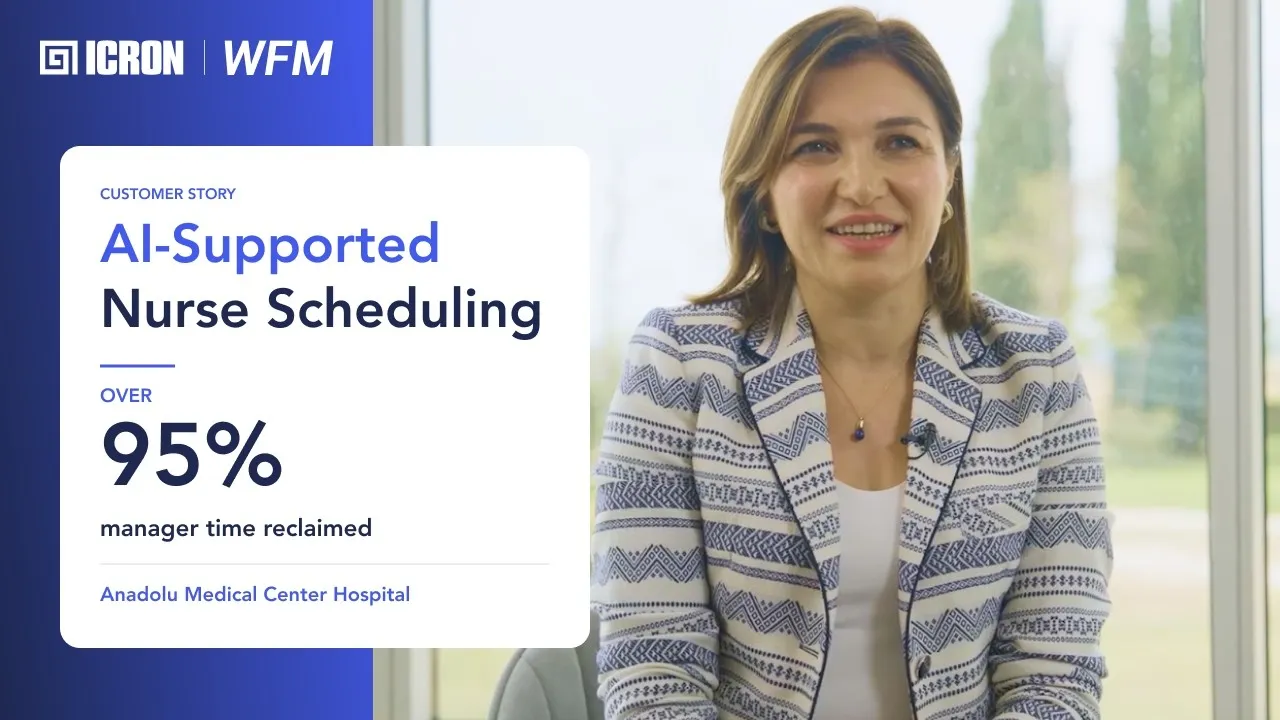
Anadolu Medical Center Hospital aimed to make nurse scheduling faster, more consistent, and easier to manage under complex hospital conditions. Nurse managers were working in an environment shaped by dozens of clinical, regulatory, and workforce constraints — from shifting workload patterns and qualification requirements to labor rules, employee requests, and the constant need to maintain fair and reliable coverage across hospital units.
The objective was not simply to digitize schedules. It was to support stronger nurse scheduling decisions across units, rules, and workforce constraints, while reducing administrative burden and giving managers more time to focus on leadership, coordination, and day-to-day operational oversight. The aim was clear: enable faster, fairer, and higher-quality shift decisions, in real time.
Support nurse managers in balancing workload, qualifications, labor rules, employee requests, and fairness more efficiently across hospital units.
Enable more reliable consideration of staffing requirements, certifications, policies, and shift rules across every schedule.
Reduce the administrative burden of monthly schedule creation and adjustments so managers can spend more time on clinical leadership.
Provide clearer schedule visibility and a more transparent experience for both managers and nursing staff.
Reduce Scheduling Complexity
Support nurse managers in balancing workload, qualifications, labor rules, employee requests, and fairness more efficiently across hospital units.
Improve Scheduling Consistency
Enable more reliable consideration of staffing requirements, certifications, policies, and shift rules across every schedule.
Reclaim Managerial Time
Reduce the administrative burden of monthly schedule creation and adjustments so managers can spend more time on clinical leadership.
Increase Process Transparency
Provide clearer schedule visibility and a more transparent experience for both managers and nursing staff.

Nurse scheduling at Anadolu Medical Center Hospital was not a simple calendar exercise. It was a multi-constraint decision problem that required nurse managers to evaluate many variables at once under changing conditions. In a 24/7 care environment, the challenge extended beyond monthly planning. Nurse managers also had to maintain minimum coverage levels, respond to exceptions such as absenteeism and clinical workload changes in real time, handle shift swaps and time-off requests, and preserve balanced coverage across day, evening, and night schedules.
Nurse managers had to simultaneously balance clinical workload by unit (e.g., ICU, NICU, oncology, specialty wards), qualifications and certifications, labor rules, rest periods, internal policies, contracts, availability, requests, and fair shift distribution.
As complexity increased, manual scheduling slowed decisions, increased cognitive burden, and extended schedule creation and adjustment work to 1 to 1.5 days per month per nurse manager.
Handling employee requests, exceptions, absences, and coverage needs manually added unnecessary supervisor workload and made it harder to maintain consistent transparency across the process.
Multi-Constraint Scheduling Complexity
Nurse managers had to simultaneously balance clinical workload by unit (e.g., ICU, NICU, oncology, specialty wards), qualifications and certifications, labor rules, rest periods, internal policies, contracts, availability, requests, and fair shift distribution.
Time-Consuming Manual Planning
As complexity increased, manual scheduling slowed decisions, increased cognitive burden, and extended schedule creation and adjustment work to 1 to 1.5 days per month per nurse manager.
Fragmented Visibility and Coordination
Handling employee requests, exceptions, absences, and coverage needs manually added unnecessary supervisor workload and made it harder to maintain consistent transparency across the process.
To support nurse managers under real hospital complexity,
Anadolu Medical Center Hospital adopted ICRON WFM as a stronger decision layer for nurse scheduling. Instead of
relying on manual coordination across multiple constraints, the organization moved toward AI-supported
scheduling that could evaluate workload, qualifications, labor rules, and fairness considerations
together, helping managers make faster, more consistent decisions with clearer visibility across the
scheduling process.
This approach aligned scheduling more closely with operational reality
across hospital units while also improving responsiveness to absences, exceptions, and day-to-day
changes. With self-service scheduling and centralized visibility, both managers and nurses gained a more
transparent, connected scheduling experience.

AI does not replace nurse managers. It supports faster, fairer, and higher-quality shift decisions, in real time.

This is not just software. It is a transformation that supports both employee satisfaction and the quality of care.



“Our shift planning process, which used to take each head nurse roughly 1 to 1.5 days every month, can now be completed in just 30 minutes — with all requests, rules, and variables taken into account.”
Birsen Civil Subaş
Director of Patient Care and Nursing Services
Optimized shift plans, built in minutes
Read MoreReal-time workload visibility across all roles
Read MoreShift swaps and time-off requests, on the go
Read MoreCoverage, compliance, and attendance, live through the dashboard
Read More